Designing for the senses is the height of luxury. Scent can transform a home, room by room

Moro Dabron and Jamb have collaborated on a scented candle vessel inspired by ancient Roman bronzes. Photograph: Moro Dabron
There is a moment in every remarkable home when something intangible takes hold—not in the contours of the space or in the choreography of materials, but in the air itself. Scent, elusive and difficult to define, is emerging as a silent signature in luxury interiors that is as powerful a design choice as a statement piece of furniture or a subtle architectural flourish.
This fall, Düsseldorf’s Kunstpalast will open “The Secret Power of Scent,” an exhibition curated by olfactory expert Robert Müller-Grünow, exploring scent as both science and art. “Scent is the most underestimated of our senses,” says Müller-Grünow. “It’s the only one directly connected to our limbic system, which governs emotion and memory. Scent is the only sensory stimulus that cannot be filtered rationally, so it triggers immediate emotional reactions.”
Working across the luxury sector, Müller-Grünow brings insight into how smell functions psychologically and as homeowners look increasingly beyond aesthetics to create immersive living spaces, the Kunstpalast exhibition feels prescient.
“Home fragrances can influence mood, mask undesirable scents, and create an atmosphere that reflects one’s personality and interior design style,” Müller-Grünow explains. “Luxury properties are pioneers in that sense: some have already integrated fragrance systems into the home at the planning stage, allowing various fragrances to be actively controlled.”

Signature scents, such as Perfumer H’s Steam Eau de Parfum, inspired by mist rolling over the hills of a forest, are becoming as much of a design choice as paint or marble. Photograph: João Sousa
The design world, too, is tuning into the emotive potential of fragrance. “Scent can do as much as marble or paint to shift the mood of a room,” says Edinburgh-based interior designer Carla Mackay. “I’ve experimented with scent layering, especially in entranceways where I want to make a warm first impression.” Cedar wood, clove and orange are inviting in fall, says Mackay who favours reed diffusers. In open-plan spaces, used sparingly to avoid overwhelming the senses. “In bedrooms, I use candles and linen sprays for curtains and bedding. Chamomile is gentle and mellow; when grounded with cedar wood, it feels warm, woody, and enveloping without being sharp.”
Fragrance designer Katie Astle echoes this interior-minded approach. “I think of a home like a story and each room is a different chapter. There’s something beautiful about having a subtle thread running throughout—a recurring note such as sandalwood or citrus, almost like having your signature scent that everyone remembers you by,” she says. “Scent gives you the ability to shift emotion room by room, while still creating a sense of flow. It’s like interior styling, but for the senses.”
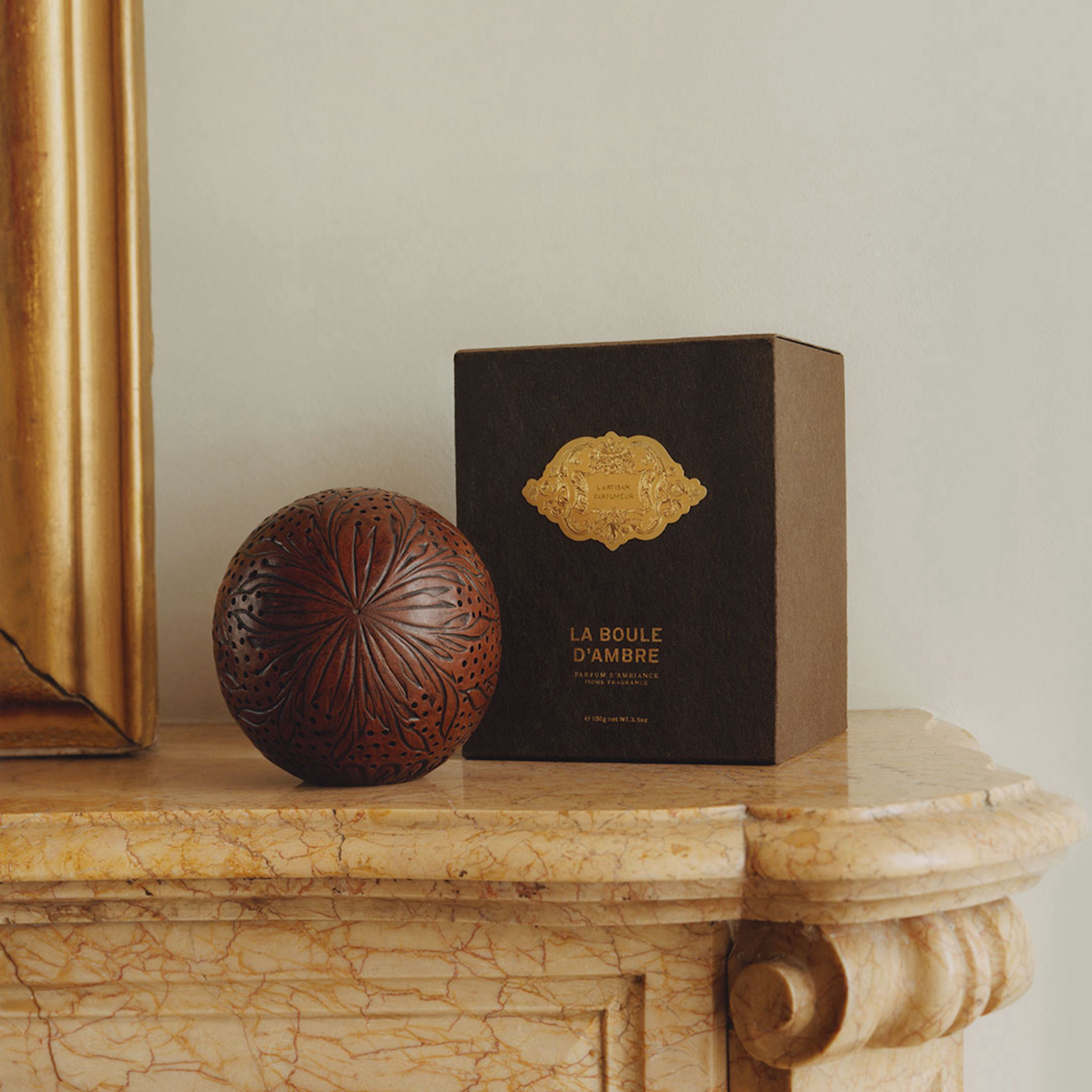
L’Artisan Parfumeur’s Amber Boule diffuser has been a coveted design object since 1976. Photograph: Supplied
Luxury fragrance brands have long recognized scent’s power to transform space. “The rapid growth of the room-fragrance market in recent years shows the importance fragrances have also gained in interior design,” says Müller-Grünow.
French perfume house L’Artisan Parfumeur’s Amber Boule diffuser, introduced in 1976, remains a cult objet d’art, celebrated for its warm, enveloping amber aroma. More recently, London design studio Moro Dabron’s latest collaboration—on a series of refillable bronze candle urns with antique fireplace company Jamb—was inspired by the frescos of Pompeii.
Fashion houses, meanwhile, are carving out new sensory experiences: Dior’s electric diffuser combines cutting-edge technology with sculptural elegance, while Loewe’s home fragrance range of room sprays, incense sets and ceramic diffusers are offered in unconventional scent profiles—think roasted hazelnut, beetroot, cucumber or wasabi. At the artisanal end of the spectrum, Lyn Harris, founder of Perfumer H, crafts home scents with a more tactile ethos. Her potpourris use botanicals gathered from the Balkans, while her incense is hand-rolled in Japan, marrying tradition with contemporary luxury.

Ai Weiwei and Herzog & De Meuron’s Serpentine Pavilion used cork for its scented properties. Photograph: © Iwan Baan
The boundaries between design, art and olfaction are blurring. At the 2024 Venice Biennale, Koo Jeong A created a scent portrait of the Korean Peninsula, brushing the air with aromas evoking red pine trees and salt air or cooked rice with soy sauce and sesame oil. This kind of storytelling echoes past architectural experiments, such as the Serpentine Pavilion in London by Herzog & de Meuron and Ai Weiwei, where the structure’s cork-clad interior released a distinctly earthy scent.
Limited-edition artist collaborations have elevated scents for the home to collectible status. Diptyque’s Fragrance of Infinity is a room fragrance housed in an optical glass bottle created with photographer Hiroshi Sugimoto. Byredo paired up with multimedia artist Dozie Kanu for an exhibition in Milan exploring the malleability of memory, taking cues from its Bal d’Afrique.
The Dusseldorf exhibition will invite visitors to rethink scent as both medium and message: Müller-Grünow presents it as central to how we experience space, memory and even visual art. Works from the museum’s collection, which spans 1,000 years of cultural history, will hang among scent columns, atomisers and diffusers, highlighting the connection between art and the senses. One gallery will diffuse a bespoke “Kunstpalast scent,” grounding visitors in a space shared by works from Rubens, El Anatsui and Gerhard Richter.
Scent functions as emotional architecture: it anchors memory and gives form to the invisible. Olfaction has become part of the spatial language of design, as vital as color, light or material in shaping how we feel in a space. As homes become more curated, sensorily rich and psychologically attuned, scent is stepping fully into the architectural conversation.
How designers use tapestry to blend old and new in strikingly contemporary interiors