
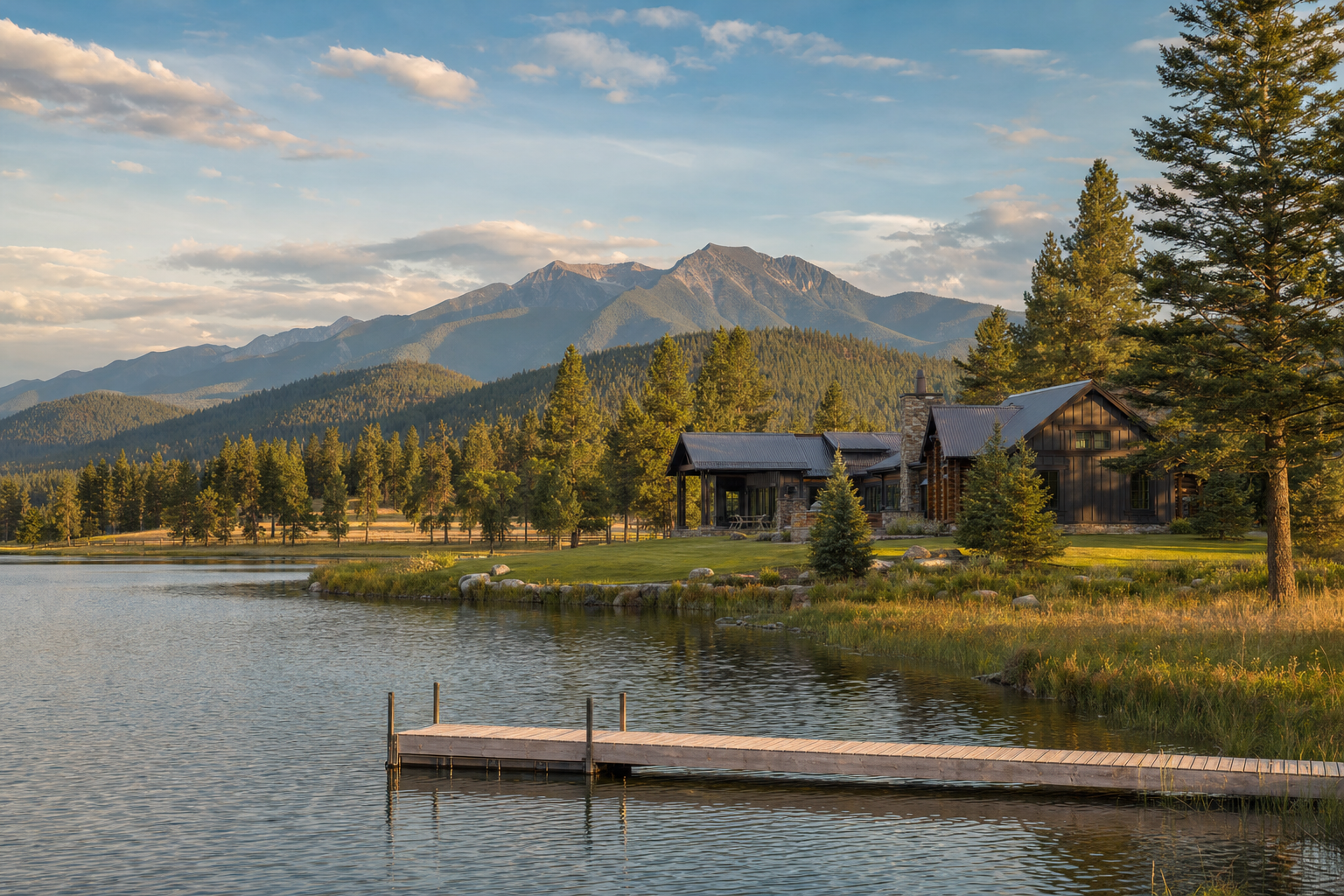
TL;DR: Lakeside Montana real estate centers on Flathead Lake access, with median home prices around $588,000 in early 2026 and deeded waterfront properties commanding $1.5M–$5M+. The market rewards strategic timing – inventory peaks May through August with 18% higher prices than winter months. Buyers should verify lake access type (deeded vs. HOA vs. none), understand well/septic requirements in this unincorporated community, and confirm short-term rental allowances if planning investment income.
What Makes Lakeside Montana Real Estate Unique?
What drives buyers to a small unincorporated community 14 miles south of Kalispell? The answer sits 197 square miles wide: Flathead Lake. Lakeside Montana real estate revolves entirely around proximity to this recreational centerpiece.
Lakeside occupies prime west-shore territory along U.S. Route 93, positioning properties between Kalispell’s regional services and Glacier National Park’s west entrance 25 miles away. Unlike incorporated Montana towns, Lakeside operates without municipal water, sewer, or city government – a factor that shapes both property characteristics and buyer expectations.
The real estate landscape breaks into four distinct categories. Single-family homes on 0.5–3 acre lots represent the baseline inventory, typically priced $400K–$750K depending on lake access. Lakefront estates with deeded shoreline access command $1.5M–$6M, offering private docks and 100+ feet of water frontage. Condos and townhomes in lakefront complexes provide shared amenities at $375K–$525K. Vacant land ranges from quarter-acre buildable lots to 10+ acre rural parcels, with lakefront lots starting around $850K.
Current listing inventory shows 57 properties as of June 2026, with median asking prices reflecting seasonal patterns we’ll examine below. The market serves three primary buyer profiles: luxury second-home purchasers seeking waterfront recreation, out-of-state relocators drawn to Montana’s lifestyle and tax advantages, and local sellers upgrading or downsizing within the Flathead Valley.
Key Takeaway: Lakeside’s unincorporated status means all properties rely on private wells and septic systems – factor $15K–$30K for well drilling and $10K–$25K for septic installation when buying vacant land.
How Much Do Homes Cost in Lakeside MT?
Lakeside Montana real estate prices center around $588,000 for the median home sale in January 2026, but that figure masks dramatic variation based on a single factor: lake access type. Understanding this pricing structure prevents costly misunderstandings during your property search.
Waterfront vs Inland Property Prices
| Property Type | Price Range | Typical Features |
|---|---|---|
| Deeded lakefront homes | $1.5M–$6M+ | 100+ ft shoreline, private dock, 3,000–6,000 sq ft |
| HOA lake-access homes | $450K–$1.2M | Shared beach/dock, 1,800–3,500 sq ft |
| Inland homes (no access) | $400K–$550K | 0.5–3 acres, mountain views, 1,500–2,800 sq ft |
| Lakefront condos | $375K–$525K | Shared amenities, 1,200–1,800 sq ft |
| Deeded lakefront lots | $850K–$1.5M+ | Buildable, 0.5–2 acres, utilities required |
| Inland vacant land | $150K–$500K | 2–10+ acres, well/septic required |
Price per square foot tells another story. Lakefront homes average $450–$750/sq ft, while inland properties run $200–$325/sq ft. The calculation changes when you factor in lot size – a $2.5M lakefront estate on 2 acres with 150 feet of shoreline delivers roughly $16,700 per linear foot of water access, the metric that truly drives value.
Seasonal Price Fluctuations
Timing your Lakeside Montana real estate purchase can save six figures. The market follows Flathead Lake’s tourism calendar with mathematical precision. Historical data reveals the pattern: July 2025 median list prices peaked at $695,000, while January 2026 dropped to $588,000 – an 18% seasonal swing.
For buyers, this creates strategic windows. November through February offers 15–20% more negotiating leverage, fewer competing offers, and sellers motivated to close before winter. The trade-off? You’ll view properties at low water levels (Flathead Lake drops 10 feet seasonally), revealing worst-case dock access and beach conditions – actually an advantage for due diligence.
Days on market data supports the seasonal thesis., but winter listings often exceeded 120 days while summer properties moved in 45–60 days. Sellers who priced correctly from the start fared better.
Key Takeaway: Winter buyers gain 15–20% negotiating leverage on Lakeside Montana real estate, but must view properties at low water levels to assess true lakefront usability – a blessing for thorough due diligence.
What Types of Properties Are Available?
Lakeside Montana real estate inventory divides into five distinct categories, each serving different buyer priorities and budgets. Current listings show properties spanning from a $415,000 starter home to a $4.99M lakefront estate and a $7.995M retreat near the water.
Single-family homes represent the market’s foundation. These properties typically sit on 0.5–3 acre lots with 3–5 bedrooms and 1,500–3,500 square feet. Most lack direct lake access but offer mountain views and proximity to Flathead Lake’s public access points. Expect private wells (drilling costs $15K–$30K), septic systems ($10K–$25K for new installation), and propane or electric heat. Premium pricing is driven by location and finishes rather than lake access.
Lakefront estates command the market’s highest prices for good reason. These properties deliver deeded shoreline access, typically 100–200+ feet of water frontage with private docks. The premium buys exclusive lake access, dock permits (often grandfathered), and beach frontage that remains usable even during winter drawdown when water levels drop 10 feet.
Condos and townhomes provide lakefront access at lower entry points. These properties cluster in planned developments with shared amenities: community beaches, boat docks, clubhouses. HOA fees run $3,600–$6,000 annually, covering common area maintenance, insurance, and dock access. The trade-off? Rental restrictions often prohibit short-term vacation rentals, limiting investment income potential.
Vacant land offers the widest price range. Lakefront buildable lots start around $850,000 for 0.5–1 acre parcels with utilities nearby. Inland acreage runs $150K–$500K depending on size and access.
Investment properties face mixed regulatory terrain. Flathead County permits short-term vacation rentals countywide, but individual HOAs impose their own restrictions. Some subdivisions ban rentals under 30 days entirely, while others allow them with registration requirements. Verify covenants before purchasing for rental income – this single factor can eliminate 40–60% of potential cash flow.
For buyers working with local expertise, Glacier Sotheby’s International Realty specializes in Flathead Lake properties and can clarify access rights, HOA restrictions, and permit requirements specific to each listing – critical details that determine long-term property value and usability.
Key Takeaway: Lake access type – deeded frontage ($850K+ for lots), HOA shared access ($450K–$1.2M), or none ($400K–$550K) – drives 60–70% of Lakeside property value differences within similar square footage.
Which Neighborhoods Should You Consider?
Lakeside Montana real estate spreads across several distinct areas, each offering different trade-offs between lake access, lot size, and community amenities. Understanding these micro-markets helps target your search efficiently.
Lakeside proper encompasses the original community core along Highway 93. Properties here mix older homes on smaller lots (0.25–1 acre) with newer construction on larger parcels. You’ll find the most walkable section of this otherwise car-dependent area, with a small commercial district offering basic services. Lake access varies – some properties have deeded frontage, others rely on public access points, and many have no direct access at all.
Lakeside Club represents the area’s luxury subdivision option. sits just south of Lakeside proper, featuring paved roads, larger lots (minimum 2.4 acres), and elevation that delivers both lake and mountain views. The development includes a private airstrip for small aircraft – a unique amenity in Montana residential real estate. HOA fees run $600–$900 annually for road maintenance and common area upkeep. Notably, Lakeside Club properties lack community lake access, so buyers pay for space and views rather than water frontage.
Yellow Bay area occupies the quieter northern section, offering a mix of older cabins and modern homes. This area attracts buyers seeking more privacy and larger lots (1–5 acres typical) at slightly lower price points than central Lakeside. The University of Montana’s Flathead Lake Biological Station operates here, contributing to the area’s research and conservation focus.
Angel Point and Big Arm technically fall outside Lakeside CDP but appear in many “Lakeside area” searches. These communities sit further south along the lake’s western shore, offering similar rural character with potentially better value – median prices run 10–15% below comparable Lakeside properties.
School district boundaries also matter. The district’s small size (under 500 students K-8) appeals to some but limits extracurricular options compared to larger Flathead Valley districts.
Amenities access varies by neighborhood. Lakeside proper offers the shortest drive to Kalispell (14 miles, 15 minutes) for groceries, medical care, and the regional airport. Southern areas like Angel Point add 5–10 miles to that commute. All neighborhoods rely on volunteer fire departments and Flathead County Sheriff for emergency services – response times average 15–25 minutes depending on location.
Key Takeaway: Lakeside Club delivers luxury lot sizes (2.4+ acres) and a private airstrip but no community lake access, while Lakeside proper offers smaller lots with mixed lake access at lower entry prices – choose based on whether you prioritize space or water.
How Do You Buy Lakeside Waterfront Property?
Purchasing Flathead Lake waterfront property requires navigating Montana-specific regulations that don’t apply to inland homes. The process involves five critical steps that protect your investment and ensure legal lake access.
Step 1: Verify access type and rights. Montana recognizes three categories of lake access. Deeded lakefront grants you ownership to the water’s edge with riparian rights – the legal right to access and use the water. HOA or community access provides shared beach and dock privileges through subdivision covenants. Public access means you own no lake rights but can use designated public boat launches and beaches. Title insurance should include specific endorsements covering water access rights, riparian boundaries, and any easements affecting shoreline use.
Step 2: Understand dock permits and regulations. Montana Fish, Wildlife & Parks requires Lakeshore Protection Permits for private docks on Flathead Lake. Existing docks may be grandfathered under older permits, but any modifications, replacements, or new construction triggers current permitting requirements. The application process takes 60–90 days and costs $200–$500 depending on dock size and configuration. Some properties advertise “dock included” but lack valid permits – verify permit status before closing, as retroactive permitting can cost $5K–$15K in legal and engineering fees.
Step 3: Account for water level fluctuations. Flathead Lake elevation varies seasonally by approximately 10 feet, managed by Kerr Dam operations. Full pool reaches roughly 2,893 feet elevation in summer (May–September), while winter drawdown drops to 2,883 feet (October–April). This 10-foot swing dramatically affects beach width, dock usability, and boat launch access. View properties during winter low water to assess worst-case conditions – that beautiful 40-foot beach in July may shrink to 10 feet in February.
Step 4: Inspect shoreline and underwater conditions. Professional waterfront inspections should include underwater surveys of lake bottom composition, dock foundation integrity, and shoreline erosion patterns. Rocky bottoms provide stable dock foundations but limit swimming areas. Sandy beaches erode more easily but offer better recreation. Steep drop-offs affect boat mooring and swimming safety. Budget $800–$1,500 for specialized waterfront inspection beyond standard home inspection costs.
Step 5: Review maintenance requirements and costs. Lakefront ownership includes ongoing responsibilities: dock maintenance and seasonal removal (some areas require winter dock removal), shoreline erosion control, aquatic weed management, and compliance with Montana’s aquatic invasive species regulations. Annual costs typically run $2K–$5K for basic maintenance, with major dock repairs or shoreline stabilization projects reaching $15K–$50K.
Montana law requires sellers to provide a Residential Property Disclosure Statement, but this doesn’t mandate professional inspections. Order independent inspections for wells (water quality and flow rate testing), septic systems (capacity and compliance), and structural components. Montana’s prior appropriation water rights doctrine means well permits and water rights should be verified through Montana DNRC’s Water Rights Query System – critical for rural properties relying on groundwater.
For out-of-state buyers, Montana authorized remote online notarization (RON) in 2019, allowing you to complete closings without traveling to Montana. However, visiting the property during winter months provides invaluable perspective on seasonal conditions that summer viewings miss.
Working with real estate experts experienced in Flathead Lake transactions helps navigate these complexities. Glacier Sotheby’s International Realty maintains specialists familiar with lakefront permitting, water rights verification, and seasonal market patterns specific to this area – expertise that prevents costly mistakes during due diligence.
Key Takeaway: View Lakeside waterfront properties during winter low water (10-foot seasonal drop) to assess worst-case dock access and beach conditions – summer viewings hide limitations that affect year-round usability and resale value.
What Are the Property Taxes and HOA Fees?
Lakeside Montana real estate carries two primary ongoing costs beyond mortgage payments: property taxes and HOA fees where applicable. Understanding both helps budget accurately for ownership.
Property tax calculation in Flathead County follows Montana’s formula: market value × 1.35% residential assessment rate × local mill levy. For 2025, Flathead County’s total mill levy was 89.32 mills (0.08932). A $675,000 home calculation works as follows:
- Market value: $675,000
- Taxable value: $675,000 × 0.0135 = $9,112.50
- Annual tax: $9,112.50 × 0.08932 = $814
This can seem low compared to other states. Montana’s assessment rate (1.35% of market value) creates the taxable base, which then gets multiplied by the mill levy. The effective tax rate works out to roughly 1.2% of market value annually, or about $8,100 for a $675,000 home. This places Montana in the middle tier nationally – higher than neighboring Idaho but lower than many coastal states.
Lakeside’s unincorporated status means you avoid city taxes but receive county-level services only. No municipal water, sewer, police, or fire departments exist – services come from Flathead County Sheriff, volunteer fire departments, and private utilities. This trade-off keeps mill levies lower than incorporated Montana towns but requires self-sufficiency for infrastructure.
HOA fees vary dramatically by property type and amenities:
| Property Type | Annual HOA Range | What’s Included |
|---|---|---|
| Lakeside Club | $600–$900 | Road maintenance, common areas |
| Lakefront condos | $3,600–$6,000 | Maintenance, insurance, dock access, amenities |
| Basic subdivisions | $200–$400 | Road maintenance only |
| No HOA (common) | $0 | Individual responsibility |
Lakefront condo HOAs carry the highest fees because they cover shared dock maintenance, beach upkeep, building insurance, and common area amenities like clubhouses or pools. HOA fees can increase 3–5% annually, so factor escalation into long-term budgets.
Special assessments represent the wild card in HOA budgeting. When major repairs exceed reserve funds – dock replacement, road repaving, septic system upgrades – HOAs levy one-time assessments on all owners. Waterfront HOAs face higher assessment risk due to expensive dock and shoreline infrastructure. Review HOA financial statements and reserve studies before purchasing to gauge assessment likelihood.
Utility costs add another layer since Lakeside lacks municipal services. Expect:
- Well maintenance: $200–$500 annually (testing, pump service)
- Septic pumping: $300–$500 every 3–5 years
- Propane heat: $1,500–$3,500 annually (depending on home size and winter severity)
- Electric: $150–$300 monthly average
- Internet: $80–$150 monthly (satellite or fixed wireless in many areas)
Total annual carrying costs for a $675,000 Lakeside home with HOA lake access might break down as:
- Property taxes: $8,100
- HOA fees: $4,800
- Utilities: $4,500
- Insurance: $2,000–$3,000
- Total: $19,400–$20,400 annually (excluding mortgage)
Compare this to a similar-priced home in Seattle or San Francisco where property taxes alone might exceed $12,000–$15,000 annually, and Montana’s appeal for out-of-state buyers becomes clearer.
Key Takeaway: A $675,000 Lakeside home costs approximately $8,100 in annual property taxes (1.2% effective rate) plus $0–$6,000 in HOA fees depending on amenities – budget $19K–$20K total annual carrying costs before mortgage.
Recommended Local Real Estate Expertise
Navigating Lakeside Montana real estate requires understanding nuances that generic listing sites miss: seasonal water level impacts on dock access, HOA rental restrictions that affect investment returns, well and septic requirements for vacant land, and permitting complexities for lakefront construction. These factors determine whether a property meets your needs and holds long-term value.
Glacier Sotheby’s International Realty Lakeside real estate experts bring specialized knowledge to Flathead Lake transactions that proves valuable during due diligence:
- Lakefront access verification: Distinguishing between deeded riparian rights, HOA shared access, and properties with no lake privileges – a difference worth $400K–$1M in property value
- Seasonal market timing: Understanding when inventory peaks (May–August) versus when negotiating leverage favors buyers (November–February)
- Permit navigation: Clarifying dock permit status, septic system compliance, and well water rights through Montana DNRC
- HOA covenant review: Identifying rental restrictions, special assessment history, and reserve fund health before purchase
- Local infrastructure realities: Setting accurate expectations for internet availability, emergency service response times, and utility costs in unincorporated areas
Our Lakeside real estate professionals live in the Flathead Valley year-round, providing perspective on winter conditions that summer-focused buyers often miss. This local presence matters when evaluating how a property performs during Montana’s 6-month heating season, not just during peak tourism months.
For buyers relocating from out of state, working with specialists familiar with Montana’s disclosure requirements, water rights law, and remote closing procedures streamlines transactions that might otherwise stall on unfamiliar regulatory requirements.
Frequently Asked Questions
Is Lakeside Montana a good place to invest in real estate?
Direct Answer: Lakeside offers strong investment potential for buyers prioritizing long-term appreciation and recreational value over immediate cash flow, with waterfront properties historically appreciating 4–6% annually but facing rental income limitations from HOA restrictions.
The investment case depends on your strategy. Waterfront properties with deeded access have shown consistent appreciation, driven by limited supply – Flathead Lake’s shoreline can’t expand, while demand from out-of-state buyers continues growing., indicating healthy demand despite higher interest rates.
However, short-term rental income faces obstacles. Many HOAs restrict rentals under 30 days, and even where county regulations permit vacation rentals, covenant restrictions can eliminate this income stream entirely. Verify rental allowances before purchasing for investment purposes – this single factor determines whether you can generate $30K–$60K in annual rental income or must rely solely on appreciation.
How competitive is the Lakeside housing market?
Direct Answer: The Lakeside market has cooled from pandemic-era intensity, with sellers accepting offers at 88–92% of asking price depending on initial pricing accuracy.
Competition varies dramatically by season and price point. Summer months (May–August) see multiple offers on well-priced waterfront properties, especially those under $2M. Winter months (November–February) shift leverage to buyers, with properties sitting 120+ days and sellers more willing to negotiate.
The market rewards preparation. For buyers, this means competitive offers on fairly priced properties but negotiating room on overpriced listings that linger.
Do you need a local real estate agent to buy in Lakeside?
Direct Answer: While not legally required, using an agent with specific Lakeside and Flathead Lake expertise prevents costly mistakes around water rights verification, dock permits, HOA restrictions, and seasonal property conditions that out-of-state buyers typically miss.
Local agents also provide seasonal context. Viewing properties only during summer months hides winter realities: 10-foot water level drops that eliminate beach access, ice damage to docks, snow load on roofs, and heating costs that can reach $3,500 annually. Agents who live here year-round offer perspective that prevents buyer’s remorse.
What are the pros and cons of lakefront property in Lakeside?
Direct Answer: Lakefront properties deliver exclusive recreational access and strong appreciation potential (4–6% annually) but require 2–3x higher purchase prices, ongoing dock maintenance costs ($2K–$5K yearly), and acceptance of seasonal water level fluctuations that affect usability.
Pros:
- Exclusive access to Montana’s largest natural lake for boating, fishing, swimming
- Limited supply drives consistent appreciation – shoreline can’t expand
- Private docks and beaches (where permitted) avoid crowded public access points
- Premium resale demand from out-of-state buyers seeking waterfront recreation
- Potential rental income in HOAs that permit short-term rentals
Cons:
- Purchase premiums of $400K–$1M+ over comparable inland properties
- Dock permits, maintenance, and seasonal removal requirements
- 10-foot seasonal water level fluctuations affect beach width and dock access
- Higher insurance costs for flood zones and waterfront exposure
- HOA restrictions often prohibit short-term rentals, limiting investment income
- Shoreline maintenance responsibilities and erosion control costs
Can you rent out your Lakeside property as a vacation rental?
Direct Answer: Flathead County permits short-term vacation rentals countywide with registration, but individual HOA covenants frequently restrict or prohibit rentals under 30 days – verify subdivision rules before purchasing for rental income.
County regulations allow STRs but require registration and safety compliance. The real restriction comes from HOA covenants. Many Lakeside subdivisions, particularly newer planned communities and condo complexes, ban rentals under 30 days to preserve residential character and reduce traffic.
Before purchasing for rental income, request HOA covenants and verify rental provisions. Some communities allow rentals with restrictions (maximum rental days per year, registration requirements), while others impose outright bans. This single factor can eliminate $30K–$60K in potential annual income, fundamentally changing investment returns.
How long does it take to sell a home in Lakeside MT?
Direct Answer: Timing and pricing determine sale speed more than property quality. Summer listings (May–August) move fastest due to higher buyer traffic from out-of-state visitors. Winter listings (November–February) face longer marketing periods but attract serious buyers rather than casual browsers.
Properties priced correctly from the start achieved a 2.5% difference that costs $15,000–$50,000 on typical Lakeside waterfront properties. Accurate initial pricing based on recent comparable sales shortens time on market and maximizes net proceeds.
For personalized guidance on this topic, a real estate professional from Glacier Sotheby’s International Realty’s Lakeside office can help you find the right approach for your situation.
Ready to Get Started?
For personalized guidance, visit Glacier Sotheby’s International Realty to learn how we can help.
Conclusion
Lakeside Montana real estate rewards buyers who understand the market’s driving forces: lake access type determines 60–70% of value differences, seasonal patterns create 15–20% pricing swings between summer peaks and winter lows, and unincorporated status requires self-sufficiency for wells, septic, and utilities. The median $588,000 home price masks dramatic variation – from $400K inland properties to $5M+ deeded waterfront estates.
Success in this market requires verifying water rights, understanding dock permitting, confirming HOA rental allowances, and viewing properties during winter low water to assess year-round usability. For buyers seeking Montana’s outdoor lifestyle with Flathead Lake access, Lakeside delivers that combination – provided you navigate the complexities with local expertise and realistic expectations about infrastructure, costs, and seasonal realities.
Whether you’re purchasing a primary residence, second home, or investment property, can help clarify the specific factors affecting properties in your target price range and preferred neighborhoods. The difference between a sound investment and an expensive mistake often comes down to understanding details that only emerge through local knowledge and thorough due diligence.