No longer the preserve of nobility, tapestry allows designers to blend old and new for strikingly contemporary interiors, writes Francesca Perry
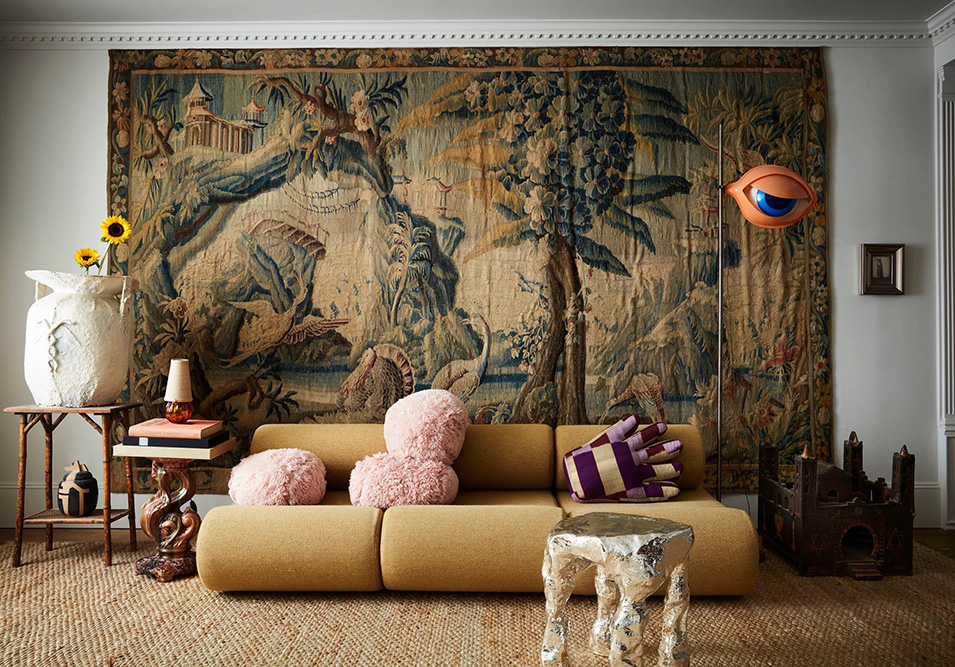 A historic tapestry in the Manhattan home of Adam Charlap Hyman, designed by CHH. Photograph: Steven Kent Johnson
Tapestries are taking over our walls again. The focus of several high-profile exhibitions and a popular feature in stylish homes, woven wall hangings—both antique and contemporary—are back in the carefully adjusted spotlight. This year has seen major shows of textile art, tapestries included, at MoMA in New York and The Clark in Massachusetts. And interior designers are also taking cues from the art world, making tapestry a central part of their schemes for private homes.
“Tapestries provide a real sense of depth when worked into a space, similar to the effect a mirror might have in a room—they play a trick on the eye, as if the space might be architecturally grander than it is,” explains Adam Charlap Hyman, co-principal of LA- and New York-based architecture and design firm Charlap Hyman & Herrero (CHH).
Wall hangings feature regularly in CHH design schemes, including the large-scale, paradise-like scene in Charlap Hyman’s own eclectically designed apartment in Manhattan. “Tapestries are different from a typical piece you might hang on the wall; they can somehow blend in and feel as if they are a natural part of the environment,” he says. “There is an incredible variety, whether in origin, palette or means of production. My favorite finds are typically of 17th- and 18th-century Aubusson and Flemish origin.”
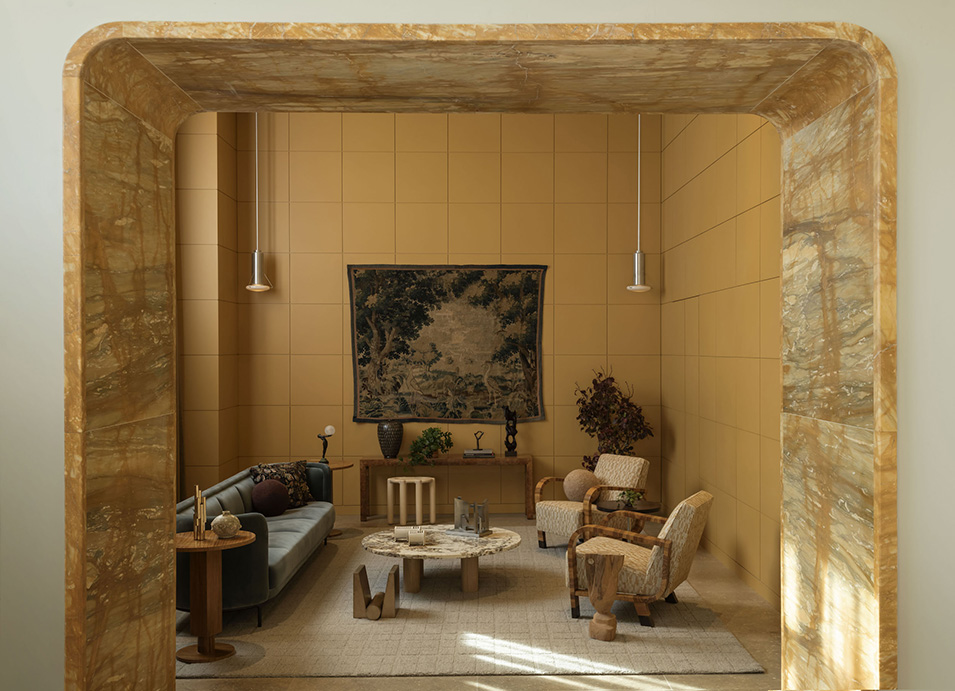 In Workstead’s lobby for One Prospect Park West, an antique tapestry provides contrast. Photograph: Matthew Williams
Throughout history, weavers have depicted current events, religious or mythical scenes, and imaginary idylls in tapestry form. The medieval period saw a peak in production, especially in Europe, when large works were made across France, Belgium and the Netherlands for castles and palaces of royalty and nobility. The capacity to showcase intricate artisanal skill combined with access to fine materials, such as silk, meant tapestries continued to thrive in the Renaissance, even as the art of painting blossomed. Tapestries were able to cover larger areas than painting, often producing a bigger impact—with the added benefit of insulating walls.
Woven works still fill the grand interiors of Château de Fontainebleau, Villa Medici, Hampton Court Palace and Quirinale Palace, to name a few across Europe. Others are now in museum collections for the public to admire. “The Unicorn Tapestries” (1495–1505), a much-feted series depicting a unicorn hunt, which originally hung in the home of a noble French family, has been on display at The Met Cloisters in New York since it opened in 1938.
In the 20th century, the bold work of artists such as Joan Miró, Anni Albers and Sonia Delaunay introduced experimental abstraction into the medium, pushing its potential. Contemporary artists including Jeffrey Gibson, Julia Bland and El Anatsui build on this experimentation, drawing from wider global influences—woven works have long been a format of creative expression in Indigenous communities across the world—and exploring unusual materials, textures and forms. Although the art world has periodically overlooked tapestries as “craft,” they are now celebrated—and collected—as artworks themselves.
 Nina Litchfield chose an abstract tapestry by Sussy Cazalet for this Notting Hill interior. Photograph: Astrid Templier
It follows that more people are incorporating tapestries into their interiors, too. As wall decoration, tapestries can be softer and warmer than paintings, but just as flexible to complementing interior styles. Their texture and tactility chime well with domestic environments and their range of sizes provides options for perfecting the right look.
In a recent project in Notting Hill, London, interior designer Nina Litchfield selected an abstract tapestry from contemporary artist Sussy Cazalet to anchor the living room. “I designed the space with the tapestry in mind,” says the Brazilian-born designer. As the rest of the room was “relatively neutral,” Litchfield wanted to bring warmth and color through a large-scale addition to the walls. Cazalet’s tapestry, sourced from the London art gallery Tristan Hoare, introduces deep red and amber tones to the room, offset by playful contrasts of red and green. “That tapestry is so fascinating, so mesmerizing—and it really makes the room,” Litchfield says.
New York-based architecture and design studio Workstead turned to historic tapestries for two interior schemes in New York. At Prospect Park West, a Brooklyn condominium development, a striking yellow lobby is offset by an antique European landscape tapestry, dominated by deep greens; at Twin Bridges House, in the Hudson Valley, a faded and framed 19th-century tapestry showing a verdant idyll complements a pattern-rich living room. “The tapestries add a historical artistry to each project,” says Ryan Mahoney, partner and creative director at Workstead.
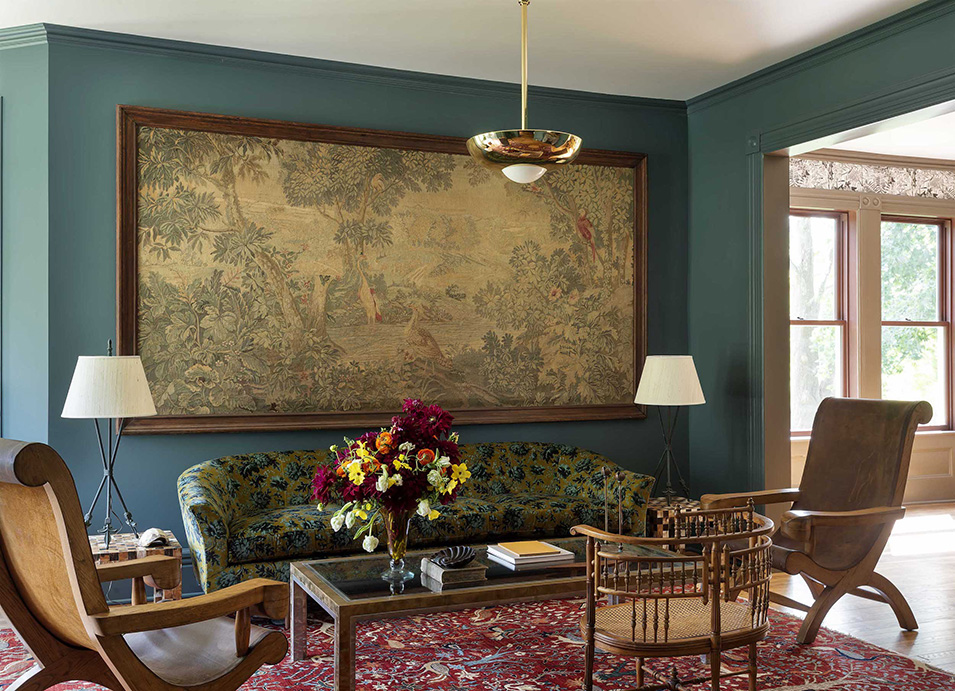 A framed 19th-century tapestry in the living room of Workstead’s Twin Bridges House. Photograph: Matthew Williams
So, how to style a tapestry in your own home? For many, contrast is the name of the game. Litchfield opted for a modern, abstract and minimal tapestry for the Notting Hill home “because my design in general is quite traditional,” she says. But just as a contemporary woven piece can offset a historic interior, so the reverse is true. “Nowadays it’s in fashion to take a very old tapestry and put it in very modern interiors,” she adds. “The modern interior can be quite cold and possibly even a little sterile—and then you put in a tapestry and it brings in warmth.”
Workstead adopted the old-meets-new approach at One Prospect Park West, where “the tapestry serves as a counterpoint to the more modern space,” says Mahoney. But a richly detailed historic tapestry can also be an opportunity to embrace maximalism. “The intricacy of tapestries encourages the layering of materials and patterns,” he says. Whatever the style chosen, tapestries can bring nuance and soul to a room. As Mahoney says: “Their soft, textured canvases enhance the depth of an interior—and can weave in storytelling.”
Books also furnish a room: read about the rise of home libraries in an age of screen overload