
Threaded with history and human endeavor, the 11th-century masterpiece is the antithesis of AI, writes Elizabeth Metcalfe

Few international exhibitions have caused quite such a frenzy as France’s historic loan of the Bayeux Tapestry to London this fall. Long before its September opening at the British Museum, nine-hour online queues for tickets resulted in the museum’s highest ever single day of sales. Meanwhile, the 224-foot (68-meter) piece arrived in July from its Normandy home in the dead of night in a specially adapted truck under police escort.
Why has this 11th-century artifact—offically not even a tapestry but a piece of crewelwork embroidery made from dyed wool and linen by anonymous hands—so enraptured the world?
“It’s a once-in-a-lifetime opportunity to see it back in the country where it was likely made,” says Millie Horton-Insch, art historian and project curator of The Bayeux Tapestry exhibition, which marks the first time in nearly 1,000 years that the work has left France. “It’s an extraordinary survival from a period when hardly any textiles still exist, let alone something the length of five double-decker buses.”

For centuries, woven wallcoverings, embroidery and crewelwork have been prized for bringing depth and tactility to interiors. “Historically they did so much for a room,” says Marta de La Rica. The interior designer often makes tapestries and embroidered textiles a central part of her schemes, including at her own home in Madrid, where an 18th-century wall hanging depicts the Queen of Sheba. “They brought color and warmth, but could also tell stories, communicate identity and completely transform the atmosphere of a space,” she says.
As designers increasingly bring antique textile pieces into contemporary homes, the qualities embodied by the Bayeux Tapestry—storytelling, craftsmanship and human ingenuity—feel particularly resonant. Chronicling the events that led up to the Battle of Hastings in 1066 and the Norman conquest of England, this historic piece certainly spins an absorbing yarn.
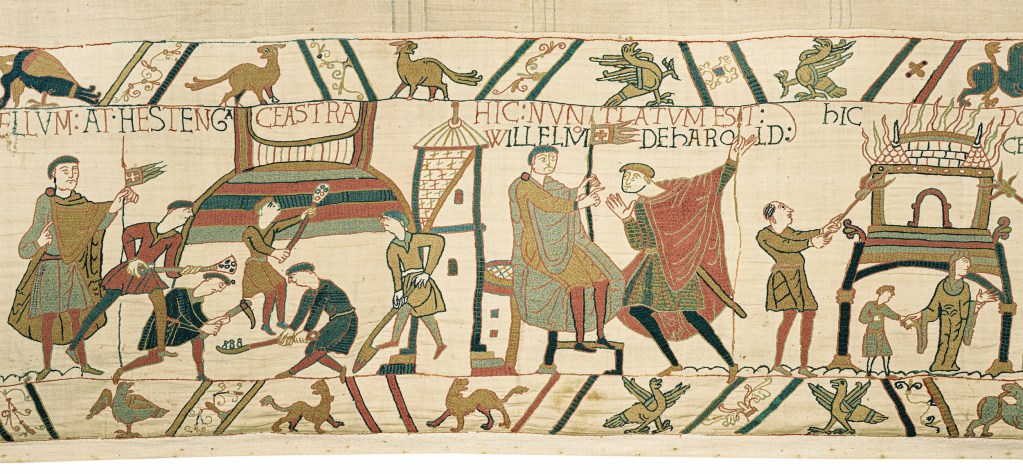
“There is death, violence, destruction and conquest, but also real moments of lightness and insights into daily life: how food was prepared and how people reacted to astronomical events such as Halley’s Comet,” explains Horton-Insch. “Communicated through a visual medium, it has this emotional immediacy that captivates people of every age,” she adds, likening the tapestry to someone “waving at you from the 11th century.” The figures may look cartoonish to modern eyes, but their expressions are relatable in their humanity.
Then there’s the sheer feat of its creation. The Bayeux Tapestry is made from four main simple stitch styles, including stem stitch for outlines and couching stitch for filled areas. But exactly how many hands were involved remains a mystery.
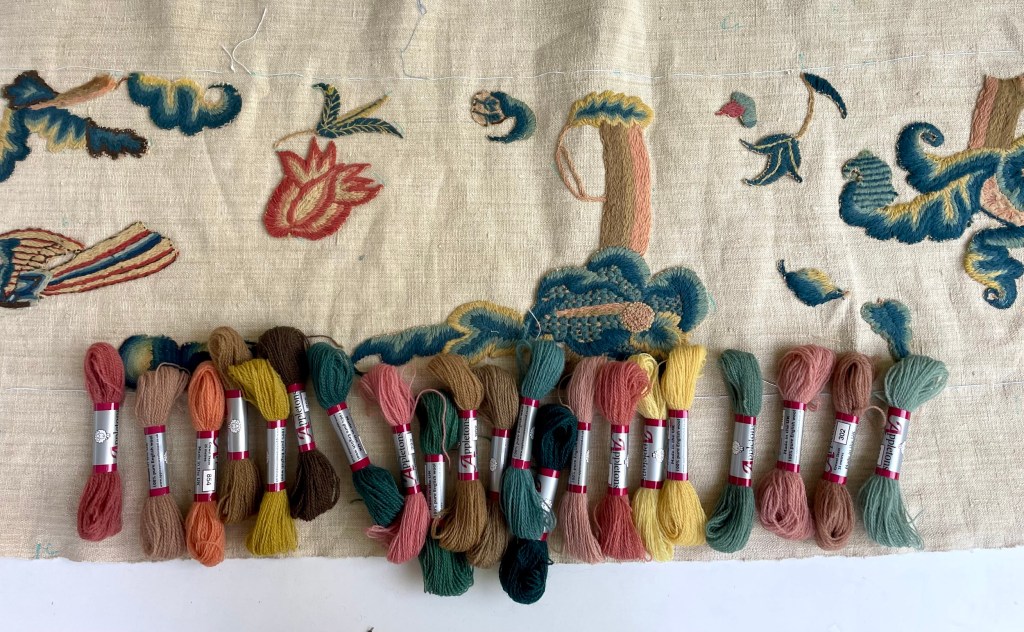
“Given the consistency of the neat, even stitching and color choices across such a huge piece, it must have been created by a group, working and communicating together,” suggests textile consultant Sarah King. Although there are only 10 colors of thread, they are deployed in a surprisingly modern and creative way. “A horse might be red or yellow in the foreground, but then blue in the background,” says Horton-Insch. “Picasso, eat your heart out!”
As Marg Dier, senior embroiderer at the Royal School of Needlework, comments: “This isn’t some cutesy embroidery project—it is massive and monumental.” Horton-Insch agrees. The linen would have to be made, the sheep raised for the wool, the natural dyes created from plants, all before any stitching took place, she explains. “Scholars estimate for every hour of embroidery work, you would have to spin wool for four to six hours. Times that across almost 70 meters and it’s mind-boggling.”

That sense of the human hand is what makes antique tapestries and embroideries such a compelling medium for high-end interiors—especially when so much of what surrounds us is digitally produced.
“They create this abstract, textural, tactile, large-scale impact in a room,” explains interior designer James Mackie, who missed out on the first round of tickets to view the Bayeux Tapestry, but “will be seriously getting on the case” in October when the next tickets will be released. Mackie recently hung a 17th-century Flemish verdure tapestry—“all amazing flora and fauna, terrifying fish and gorgeous little boats”—in his Cotswolds cottage. There, it enlivens the corner of a guest room. Historically, such pieces also served the very practical purpose of insulating cavernous, drafty rooms and absorbing noise.

“Tapestries bring stories with them not just in their narratives, but in their journeys across continents and the many hands they have passed through,” explains interior designer, antiques dealer and furniture maker Max Rollitt, who often uses 17th- and 18th-century Aubusson tapestries in projects. “These stories seem more valuable now than ever.”
For interior designer Joanna Plant, who hung a 19th-century English crewelwork panel above her London staircase, tapestry and embroideries occupy a unique position: “They carry history without feeling precious. Though often decades or centuries old, they sit happily with something brand new and somehow make both look better,” she says.
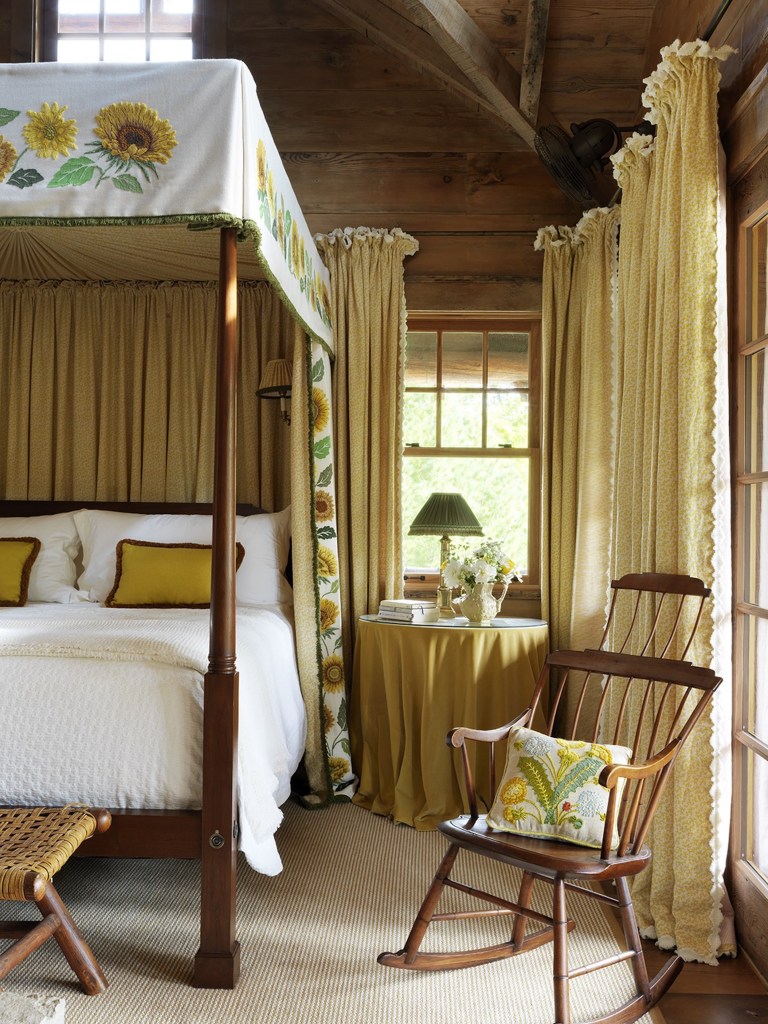
Antique wallcoverings can work particularly well in contemporary settings, suggests Mackie, bringing “warmth and tactility” to modern white-box-style interiors. And while loom-made Aubusson tapestries have long been popular, crewelwork is attracting renewed attention, which the already blockbusting Bayeux Tapestry exhibition will only amplify.
“The combination of hand stitching and wool thread on linen fabric has such a natural, beautiful, calming effect on an interior,” explains King, a crewelwork specialist who recreated some 17th-century fragments for the British businesswoman Carole Bamford to use around a four-poster bed. “Crewelwork is slow, soft and human—it couldn’t be further from AI.”
The Bayeux Tapestry is at the British Museum, London from Sept. 10, 2026 to July 11, 2027
Decorating with tapestries? Explore further interior design inspiration here