
THE FIRST-EVER WINTER CARNIVAL: FINDING ROOTS AT WOODCHUCK HILL
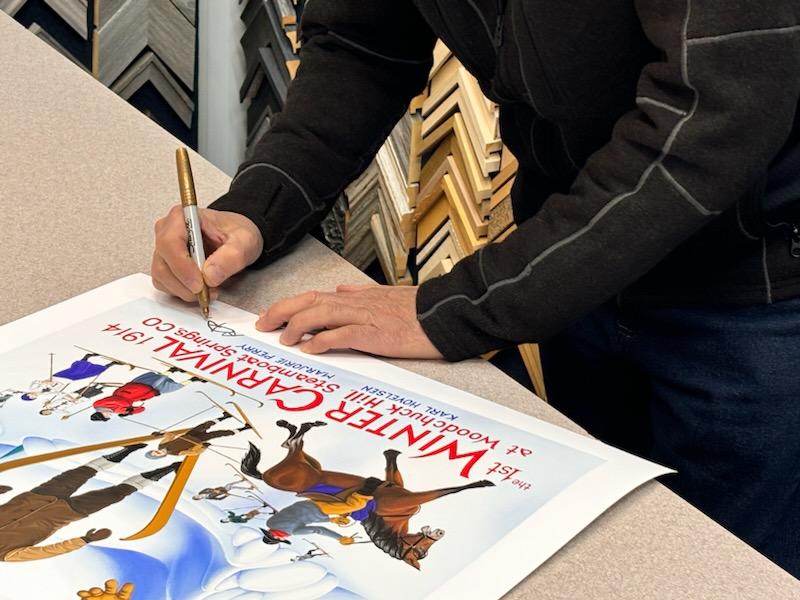
When Robert “RC” Dieckhoff learned he was selected as the artist to create this year’s Winter Carnival poster, the first thing he did was take a deep dive into its history. Inspired by the first-ever Winter Carnival in 1914, which was held at Woodchuck Hill (the current site of Colorado Mountain College), he researched everything from locating the precise spot where the first ski jump was erected and the purpose of the inaugural event to its geology and spent countless hours going through photo archives at the Tread of Pioneers Museum. “I was surprised to learn that a lot of people didn’t know the first Winter Carnival was before Howelsen Hill even existed.”
It’s not surprising Dieckhoff turned to history and geology to begin the process of creating the design for the poster. The intricate analysis and theories Dieckhoff employs in his extensive creative process involve a multidisciplinary approach to creativity that integrates science, math, and history. “I won’t go beyond an initial sketch until it fulfills a mathematical formula; math is the foundation of our physical reality” says the 76-year-old, who has lived in Steamboat since 1998. “The spatial relationship is how one space, created by shapes, relates to another by size, shape, color, density and position. To be an artist, you have to understand physics. It’s integral to everything.”

A LIFE SHAPED BY ART
 A young surfer who grew up in San Diego, Dieckhoff started painting when he was four years old. But it wasn’t until 1967 when his mother, also a professional artist, entered one of his paintings in the Cabrillo Arts Festival that he realized his potential. “I was in Vietnam and didn’t even know she’d entered my painting in the contest,” he says. “It won second place, and I didn’t even know how I did it or exactly what I had done, I just knew I wanted to do it again, to figure out how to replicate it.” His lifelong career began painting signs for a local surfboard company in exchange for surfboards, and quickly evolved into illustration, doing commercial work for magazines and manuals, and eventually fine art.
He quickly outgrew the tedium of working with oil paints (“took too long to dry,” he says) and moved onto acrylics and an early interest in digital graphic art that, in the 1970s turned out to be ahead of its time. “My professor told me the computer I’d need would cost 250 thousand dollars,” he says with a laugh. “I said, ‘forget that.’”
After his tour in Vietnam as a Navy radio technician, Dieckhoff traveled to Japan in the late ‘60s where he became fascinated by the Ukiyo-e Japanese masters. “It was an accepted way of doing things, as in Impressionism, Surrealism or Abstractionism,” he says, and it’s continued to have a huge influence on his work to this day. Characterized by a vibrant color palate, bold outlines to define shapes, and the unique spatial effects and perspective, Dieckhoff’s designs are characterized by surrealism—or what he calls “peripheral compression”—that evoke an almost psychedelic quality reminiscent of the era when he came of age.
“I’ve heard people describe it as a fisheye, but the eye can actually see a view scape of more than 260 degrees with a peripheral perspective,” he says. “I’m taking that and squeezing it into a narrower rectangle to emphasize a subject or a certain component of the design.” Dieckhoff says he views his subjects through proportional relationships woven in dynamic equilibrium with a play of color and contrast to define dimensions. Now that technology has caught up and become considerably more affordable, Dieckhoff has finally been able to create his designs on an iPad Pro, though he still uses a sketchbook outside and takes dozens, and sometimes hundreds of photographs to bring back to his studio. “They haven’t designed a screen I can see in sunlight yet,” he says.
FINDING INSPIRATION IN THE YAMPA VALLEY
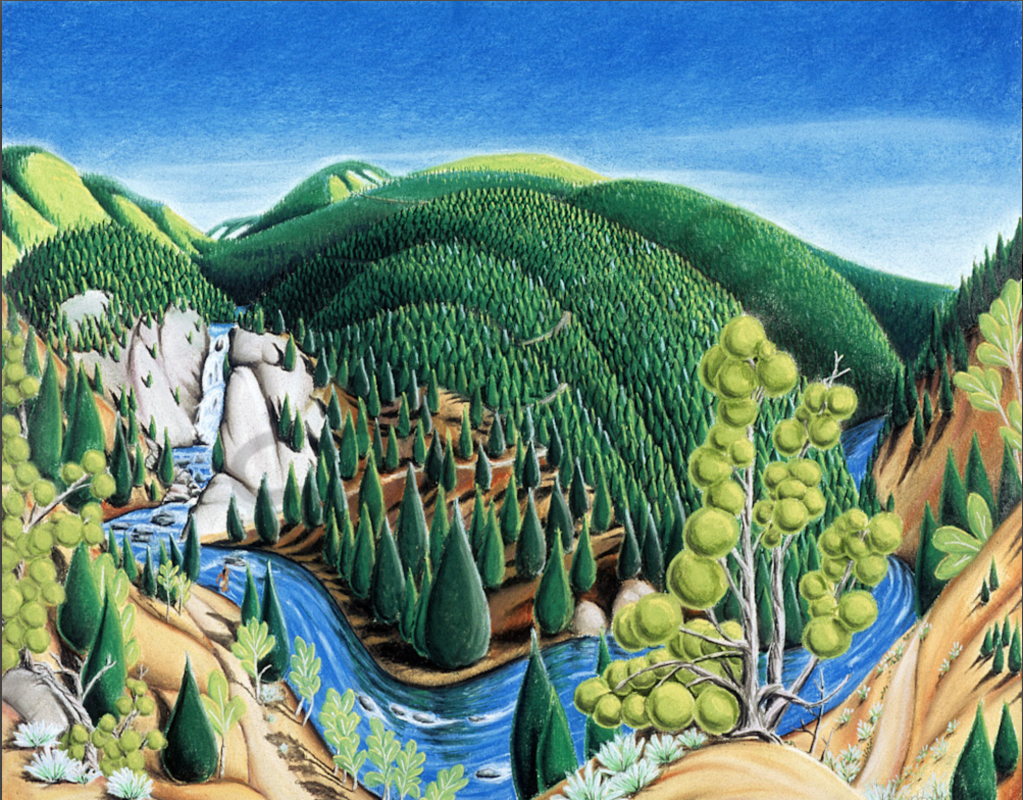
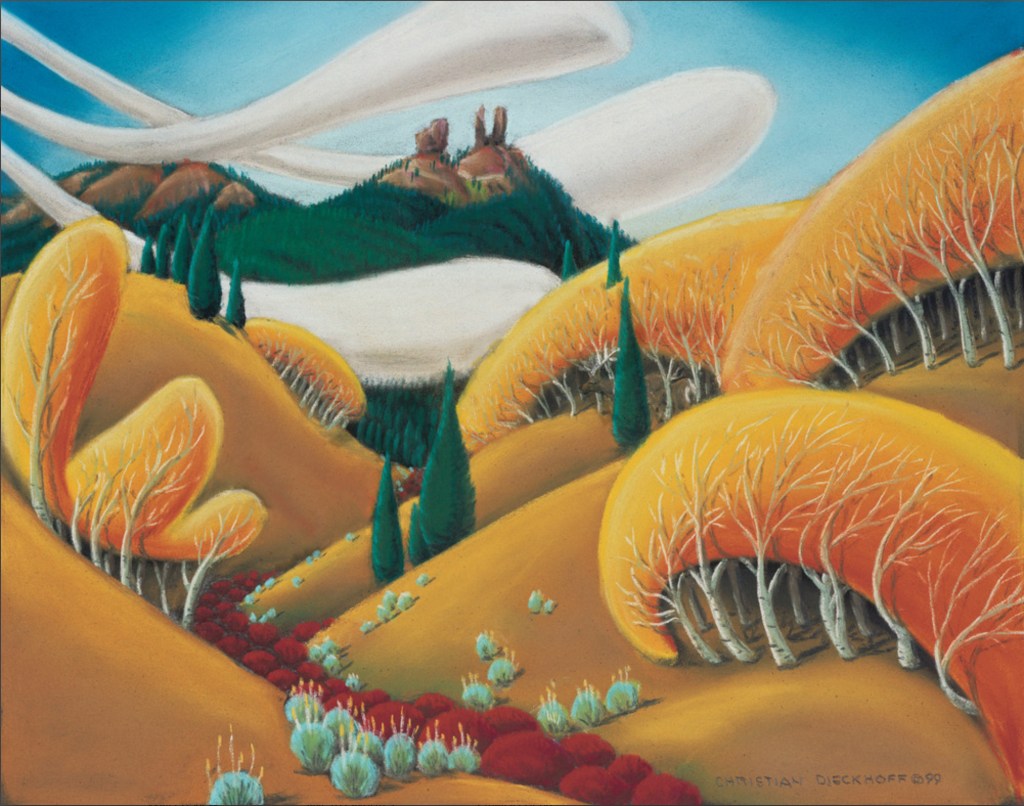

 Dieckhoff says he’s found a lifetime of abundant inspiration in the iconic landscapes of the Yampa Valley. “Northwest Colorado is particularly sacred and unique because it sits in an impact zone where the plains meet the mountains,” he says. “This creates energy, stimulates imagination and encourages artists to touch space.”
From his roots as a ski bum working odd jobs, Dieckhoff became a prolific artist over the last 52 years and has shown his work at galleries ranging from the White House to Hawaii. He’s also had an integral role in the local art community as the Founding President of the Steamboat Art Museum, Steamboat Public Art Board, and curator for the Steamboat International Art Board.
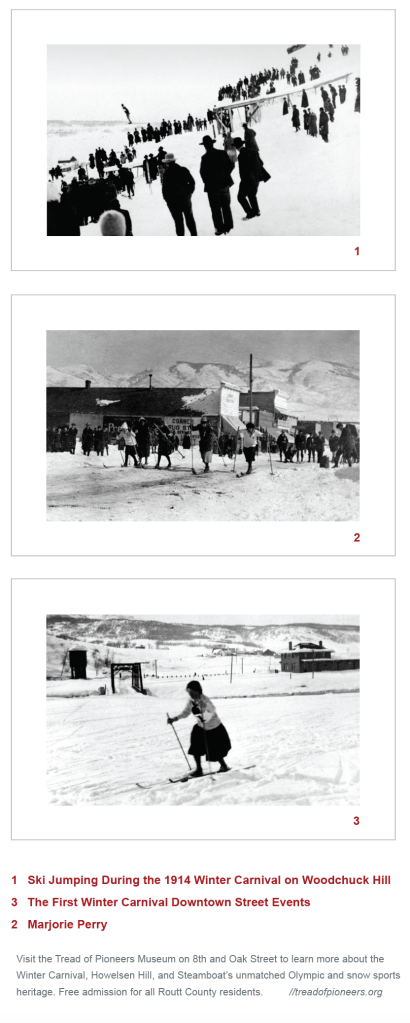
He spent countless hours on sifting through all the photo archives on the Tread of Pioneers website to learn as much as he could about that inaugural Winter Carnival event before he even thought about sketching. He discovered that when Marjorie Perry took the train to nearby Hot Sulphur Springs, Colorado to attend a Winter Carnival event, she watched Carl Howelsen ski jump. She managed to convince him to then come to Steamboat, where he built a jump on Woodchuck Hill, and the first Steamboat Carnival was born. It also introduced Steamboat to competitive skiing and ski jumping, which until then, had only been used for transportation.
Consistent with techniques employed by Ukiyo-e masters, Dieckhoff repeats Howelsen’s figure three times in the Winter Carnival painting that also features the bold colors and challenges in perspective that have come to define his work. “I hope that the poster will commemorate this piece of Steamboat history and this site on Woodchuck Hill as the original Winter Carnival venue,” he says. “It was truly an honor to be a part of it.”

//photographicsart.com